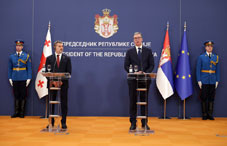
Kavelashvili Visits Serbia in First European Trip Amid Strained Ties With the EU
By Liza Mchedlidze
Friday, December 19, 2025
Georgian Dream-elected President Mikheil Kavelashvili traveled to Serbia this week in his first visit to a European country since assuming office, holding high-level talks that focused on expanding bilateral relations while tensions with European institutions persist.
Kavelashvili met with Serbia's top leadership, including President Aleksandar Vucic and parliamentary speaker Ana Brnabic, and took part in extended discussions with senior officials from both governments. The visit marked a broadening of his foreign engagements, which until now had largely been limited to Georgia's neighboring states.
Relations between Tbilisi and several Western capitals remain strained following Georgia's disputed parliamentary elections in late October, after which Kavelashvili was selected as president by a one-party electoral college. A number of international partners have questioned the legitimacy of that process, constraining official contacts.
At a joint press appearance in Belgrade, President Vucic said the talks showed strong alignment on core principles governing relations between states.
"We understood each other very well," Vucic said, adding that respect for sovereignty and territorial integrity remains central to cooperation between Serbia and Georgia. He stressed that this position "will never change."
Vucic announced plans to begin negotiations on a free trade agreement and said he expects the process to be completed next year. He also spoke about expanding cooperation in agriculture, artificial intelligence, and defense-related industries, as well as strengthening economic ties more broadly.
He noted that direct air links between the two countries are improving connectivity and confirmed that Serbia plans to open an embassy in Tbilisi. Vucic also pledged continued mutual support in international organizations and praised Georgia's economic growth.
In his remarks, Kavelashvili drew parallels between Georgia's and Serbia's experiences with the European Union, criticizing what he described as unfair treatment from Brussels.
"The attitude of European bureaucratic leaders toward our country is unfair and often reflects double standards," Kavelashvili said.
Turning to regional security, he said Georgia has resisted pressure connected to the war in Ukraine and has prioritized stability.
"We protected our national interests and adopted a firm and principled position," he said.
Kavelashvili also pointed to the strategic importance of the South Caucasus as a corridor between East and West, suggesting that closer cooperation with Georgia could offer Serbia new opportunities in trade and transit.
The visit concluded with expanded talks between the two delegations on cooperation in education, research, youth exchanges, and innovation, signaling an intention by both governments to deepen ties beyond political dialogue.