EU Ambassador Warns Georgia Drifting From Europe
By Messenger Staff
Monday, May 11, 2026
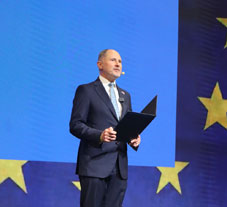
EU Ambassador to Georgia Pawel Herczynski used a Europe Day event in Tbilisi on May 9 to deliver a pointed message about Georgia's stalled path toward EU membership, drawing a sharp response from Georgian Dream officials who called him a "tragic person" and skipped the event entirely.
Herczynski framed the EU as a longstanding and reliable partner. "Since the restoration of independence, we have stood by Georgia, by you, as a strong and reliable partner," he said, describing the EU as "a space of diversity, where each state not only preserves, but also strengthens its culture, identity and traditions." He said Georgia is admired in Europe "precisely for its uniqueness and rich culture."
Herczynski also said Georgia had recently "stopped moving towards the European Union," adding that anti-European rhetoric was "further damaging the friendship built over the years and the hope of generations." He argued that EU membership remains "the best way to maintain peace and prosperity," citing nearly 80 years of EU history as evidence. He concluded with a direct appeal: "Forward, Georgia, forward!"
Despite the critical message, Herczynski said the EU had not written Georgia off. "We do not lose hope that Georgia will one day become a member of the European Union. Therefore, we are ready to renew our work together to achieve this goal," he said.
Before the event, Georgian Dream Parliament Speaker Shalva Papuashvili published an open letter to Herczynski on social media. The letter focused on the symbolic meaning of the 9th of May and the founding principles behind the EU. Papuashvili repeatedly quoted Robert Schuman, one of the EU's founding figures, arguing that modern European policy had moved away from his vision.
Papuashvili criticized Herczynski's Europe Day message from last year, saying the ambassador had chosen to ignore the end-of-war anniversary and instead focused on political claims against Georgia. "There is no family in Georgia that did not suffer losses during the war.
Separating Europe Day from Victory Day is unacceptable for us," he wrote, calling on the EU to pay tribute to the 300,000 Georgians who died fighting fascism.
Papuashvili accused the EU of pursuing policies "aimed at deepening confrontation and intensifying divisions," citing what he called "unjust and politically motivated resolutions of the European Parliament, numerous threats of political and economic retaliation, and constant interference in Georgia's internal affairs."
One of the sharpest sections addressed violence and radicalism. Papuashvili claimed EU representatives had failed to publicly condemn what he described as an "attempted coup" linked to events on October 4 last year. "For more than seven months, not a single senior European official has publicly condemned this attempted coup, as if violent overthrows of governments were a normal practice in European politics," he wrote.
He also touched on economic pressure, saying the EU had demanded Georgia participate in economic confrontation with Russia without offering security guarantees or economic support, which he argued would threaten Georgia's economic and regional stability.
Concluding the letter, Papuashvili called on the EU to halt what he described as hostile rhetoric and to return to dialogue based on "peace, cooperation, and unity grounded in respect for nations and their identities."
Irakli Kobakhidze did not attend the event. "Mr. Herczynski has been doing everything he can to spoil relations between Georgia and the European Union for years," Kobakhidze told journalists. "He was tasked with strengthening and deepening relations between the European Union and Georgia, and in fact, he did everything to the contrary, because he had such a task. He is a tragic person; the event that is being held under his leadership, unfortunately, does not have much value."
Papuashvili also stayed away, saying he had no desire to attend what he expected would be "another anti-government rally organized by the EU." He questioned whether opposition figures he linked to past unrest would appear at the event, saying their presence "shows who is really behind the hatred, violence, confrontation and radicalism in Georgia."
Herczynski confirmed receiving the letter and said it had been forwarded to Brussels, with a response coming "in due course." When asked whether government officials had been invited, he said the event was open to all. "You would see posters in the city, as well as advertisements on social networks. Anyone who wants to can join us and celebrate Europe Day with us," he said.
German Ambassador Peter Fischer responded critically to the letter. "I am a little worried about Mr. Papuashvili; he either doesn't really understand what Europe is or pretends not to understand, neither of which is good," Fischer said. He rejected the accusation that the EU was harming relations with Georgia, saying Georgian citizens "know very well" that Europe has been a friend and partner since independence. "We do not accept this criticism, we reject this criticism," he said, adding that the EU is "a peaceful, free and prosperous place and Georgians are very welcome to be with us, our friends and partners."
Herczynski declined to engage with Kobakhidze's remarks. "From the very first day of my arrival in Georgia, my policy has been not to comment on what Georgian politicians say about me," he said. "It is a great honor to represent the European Union in Georgia, and I am trying to do it as well as possible."