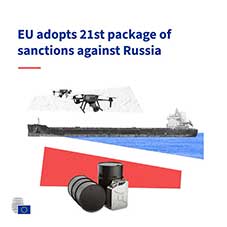
EU Sanctions 14 Crypto Platforms, Georgian Oil Refinery in Latest Measures Against Russia
By Messenger Staff
Friday, July 24, 2026
The European Union has approved a new package of sanctions against Russia, expanding restrictions on the country's financial sector, cryptocurrency services, and oil industry. The measures include sanctions on 14 cryptocurrency-related platforms, a Georgian oil refinery, dozens of financial institutions, and several entities linked to Russia's energy sector.
In a statement, the Council of the European Union said the latest measures are aimed at increasing pressure on Russia's economy.
"Today, the EU is significantly expanding action against Russia's financial and banking sector as a vehicle of Russia's war economy."
The package freezes the assets of 94 banks and major financial institutions and prohibits EU operators from making funds available to them. It also extends the EU's transaction ban to 33 additional Russian credit and financial institutions.
The Council said the EU is also imposing a transaction ban on a bank in Kyrgyzstan linked to Russia's System for Transfer of Financial Messages (SPFS), as well as three other non-Russian banks that it said were helping Russia evade existing sanctions.
The new package also targets cryptocurrency services. The EU extended its transaction ban to 14 crypto-related service platforms based in Georgia, Panama, the United Arab Emirates, the Marshall Islands, Kyrgyzstan, and Belarus.
In addition, the Council said it had listed four entities connected to the cross-border A7 network, including new links to Africa.
The sanctions also expand pressure on Russia's oil sector. The EU designated 18 entities and one individual, including three Russian refineries, a major Belarusian refinery, and a company created to sell Belarusian petroleum products within Russia.
Among the measures is a transaction ban on the Kulevi oil refinery in Georgia, which the EU said trades and processes Russian oil. The restriction will take effect in six months.
"The package creates the possibility to prohibit transactions with listed refineries in Russia and in third countries which process or refine Russian crude oil and petroleum products. In that framework, the EU is imposing a transaction ban, entering into force in six months, on a Georgian refinery trading and processing Russian oil in Kulevi," the Council said.
The Council also added five oil traders to its transaction ban list, saying they had undermined the EU's restrictions on the purchase of Russian crude oil and petroleum products.