State Security Service Rejects BBC Allegations About Chemical Agents Used During Protests
By Liza Mchedlidze
Monday, December 8, 2025
Georgia's State Security Service has pushed back against a BBC investigation that suggested police deployed a hazardous chemical agent during last year's demonstrations. Officials said the only crowd control compound used in recent years is CS gas, a standard tear gas employed by law enforcement worldwide, and insisted that the Interior Ministry has never purchased the substance identified by the BBC as camite.
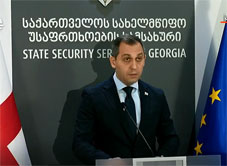
Deputy Security Service Head Lasha Maghradze said investigators have already clarified which chemicals were used during the tense overnight dispersal of December 4 and 5.
"The powder procured by the Ministry of Internal Affairs and applied during protests when necessary is chlorobenzylidene melanonitrile," Maghradze told reporters. "During the events in early December, that was the active substance, and the solvent applied with it was propylene glycol."
He did not address whether the material had been mixed with water cannon jets, as the BBC had implied, but emphasized that the compound is always combined with a solvent when deployed.
At the briefing, officials presented images of industrial containers labeled with chemical names and international shipment codes. Maghradze said Georgia obtained its supplies of CS gas from an Israeli company in 2007. When the gas and the solvent trichloroethylene were transported together in 2009, he noted, they were assigned the transport identifiers UN3439 and UN1710. Those same codes appeared in a 2019 inventory list cited by the BBC.
Maghradze argued that the presence of the codes is not unusual. According to him, Georgian institutions have used these classifications to import a wide range of civilian and industrial products more than six hundred times over the last twenty years. He added that authorities recently collected 880 liters of leftover trichloroethylene from the Special Tasks Department, the Interior Ministry unit responsible for riot control.
The deputy director also rejected claims that police may have used bromobenzyl cyanide, or camite, describing it as a dangerous compound with severe health consequences. "The Ministry has never purchased such a substance," he said. He pointed to Health Ministry data showing that only five of the fifty four people hospitalized after the late November protests had mild poisoning symptoms and all were released the next day.
The security service launched a broader investigation on December 1, hours after the BBC report was published. Maghradze said investigators have questioned ninety three witnesses, including demonstrators, NGO representatives, doctors, and both past and present Interior Ministry officials. Twenty five samples have been sent to the Levan Samkharauli Forensic Bureau for testing.
One individual cited by the BBC has not been interviewed. The broadcaster identified Lasha Shergelashvili as a former weapons specialist who suggested that police might have used a chemical similar to one he had tested years earlier. Maghradze said Shergelashvili is currently in Ukraine and is wanted in another criminal case concerning an arms cache discovered near Tbilisi in early October.
"The investigation is examining a scenario in which Lasha Shergelashvili, working with Ukrainian special services, instructed Beka Chulukhadze to acquire explosive materials and hide them near the capital," Maghradze said. This marks the first time Shergelashvili has been publicly linked to that case.
Maghradze concluded by sharply criticizing the BBC report. "It is complete and deliberate disinformation meant to harm Georgia's interests," he said, adding that the inquiry into alleged cooperation with a foreign organization remains ongoing.