Public Defender to Challenge Georgia's Anti-Protest Laws in Constitutional Court
By Liza Mchedlidze
Friday, December 26, 2025
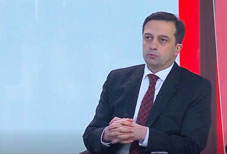
Georgia's Public Defender Levan Ioseliani said his office will ask the Constitutional Court to review a series of protest-related amendments adopted by the ruling Georgian Dream party in 2025, arguing the measures violate the principle of proportionality.
Speaking in an interview on December 24, Ioseliani said the new rules impose excessively harsh penalties and leave courts with little room to apply alternative sanctions. "What we see is precisely a problem of proportionality and commensurability, using imprisonment without alternative and introducing criminal responsibility directly after that," he said, adding that this aspect "should be challenged before the Constitutional Court of Georgia."
Over the past year, Georgian Dream has steadily tightened regulations on public assemblies. Earlier administrative fines for actions such as blocking roads or covering faces during rallies were replaced with detention, while December amendments expanded restrictions to include protests in pedestrian areas and introduced stricter advance notice requirements for demonstrations.
Ioseliani warned that advance notice rules, while mentioned in the Constitution, risk becoming a tool to effectively authorize or block protests. "A provision on notice exists in the Constitution; this is not new," he said. "However, it is important that such notice does not turn into something resembling mandatory sanctioning, which would itself contradict the Constitution."
He also criticized the blanket ban on face coverings during demonstrations, which is now punishable by detention. "I think this is a disproportionate sanction in relation to assemblies, and in general, it is illogical how one can prohibit a person from using a face covering," Ioseliani said.
Addressing penalties for blocking roads, the Public Defender said imprisonment removes judicial discretion. He cautioned that laws introduced in response to specific protests, including near Tbilisi's Rustaveli Avenue, could later be applied far more broadly. "The fact that certain events are taking place on Rustaveli Avenue cannot be extended to everyone," he said, warning the amendments could restrict expression in non-political protests as well.
Ioseliani stressed that freedom of expression must be balanced with other rights but said large demonstrations can legitimately occupy streets. "If we see a sufficient number of people, they have a full and legitimate right to block both pedestrian areas and roadways," he said. "If such a number is not present, a small group does not have such legitimacy."
The Public Defender previously requested an urgent opinion from OSCE/ODIHR on the fast-tracked amendments. The body's assessment, released in November, called for repealing the legislation, citing "serious concerns" over Georgia's compliance with international human rights obligations.