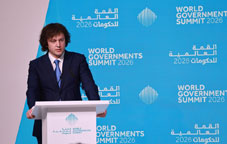
Kobakhidze: Middle Corridor 'An Inevitability' in Fragmented Global Economy
By Liza Mchedlidze
Wednesday, February 4, 2026
Georgian Dream Prime Minister Irakli Kobakhidze positioned Georgia as a vital link between East and West on Tuesday, telling world leaders that the "Middle Corridor" has evolved from a mere alternative to an "inevitability" for global trade.
Speaking at the 2026 World Government Summit, Kobakhidze argued that as traditional trade routes face mounting instability, the world is increasingly looking for corridors that can bypass geopolitical friction.
"The Middle Corridor offers something increasingly rare in today's world: a stable, reliable transit route that overcomes geopolitical divides," Kobakhidze said. "In a world where traditional routes are unreliable, alternative corridors are essential."
Kobakhidze emphasized that in an era of global fragmentation, Georgia's strategic position allows it to serve as a "bridge" rather than a pawn in geopolitical competition. He noted that the route, which connects East Asia to Europe through Central Asia, the Caucasus, and Turkey, provides landlocked countries with critical access to global markets.
He stressed that the current global economic climate requires "intelligent diversification" rather than isolation or choosing sides.
"In a fragmented global economy, countries that can bridge the gaps are invaluable," he noted. "The world doesn't need to choose sides-it needs reliable connecting bridges."
The speech comes as Georgia continues to invest heavily in its transit capabilities, including the Baku-Tbilisi-Kars railway and the Anaklia deep-sea port project. Kobakhidze argued that stability itself has become a "strategic asset" that Georgia can offer its international partners.
According to Kobakhidze, the goal is to transform the country into a multifunctional regional hub that can withstand geopolitical shocks while ensuring economic prosperity for the region.
"The question before us today is how to create a trading system that is resilient enough to withstand geopolitical shocks and open enough to ensure prosperity," Kobakhidze concluded.