Georgian Dream Pushes Bill to Criminalize 'Systematic' Non-Recognition of Government, Proposes Up to 3 Years in Prison
By Liza Mchedlidze
Tuesday, February 17, 2026
The ruling Georgian Dream party plans to criminalize what it describes as systematic refusal to recognize the legitimacy of the government and other constitutional bodies, with penalties of up to three years in prison.
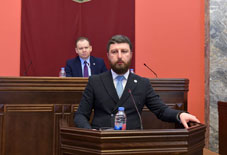
The proposal was presented on February 16 at the Legal Issues Committee of Georgia's disputed parliament by committee chair Archil Gorduladze. The changes are part of a controversial legislative package that introduces further restrictions on foreign grants and has already passed its first reading.
The idea of criminalizing refusal to recognize the legitimacy of the government was first raised during a parliamentary plenary session on February 4. During that discussion, ruling party lawmakers referred to Germany's experience, later citing the 2025 ban of Germany's far-right Reichsbürger movement. Party leaders appeared to compare that case with opposition groups and citizens who question the legitimacy of the Georgian Dream government.
At the February 16 committee hearing, Gorduladze read out a proposed new article to the Criminal Code, Article 316 Prima, titled "Extremism Against the Constitutional Order."
According to the draft, the article would apply to Georgian citizens and non-citizens who make "systematic and public calls" for "the mass violation of legislation, mass defiance of Georgian government bodies, or the creation of alternative authorities."
It would also target people "who systematically and publicly present themselves, or another person, as a representative of the Georgian government."
The article further covers "other systematic actions aimed at creating the perception that Georgia's constitutional order or its constitutional bodies are illegitimate, and that harm Georgia's interests or create a real danger to harm those interests."
Gorduladze said penalties could include an unspecified fine, 400 to 600 hours of community service, or up to three years in prison.
He said the key criteria for the offense are that actions are "systemic, systematic, and public."
"A single person's actions, of course, will not be considered a criminal offense," Gorduladze said, adding that the approach would draw a "clear line" between freedom of expression and criminal activity.
The proposal also introduces refusal to recognize the legitimacy of constitutional bodies as an aggravating circumstance for other crimes under the Criminal Code.
"When imposing a sentence, committing a crime with the motive of refusing to recognize Georgia's constitutional order or constitutional bodies will be considered an aggravating circumstance," Gorduladze said. He added that such a sentence must exceed the standard term for the crime by "at least" one year.
Commenting on the draft law, Georgian Dream Prime Minister Irakli Kobakhidze drew a comparison between Russia and what he described as extremist forces inside Georgia.
"Russia and four other countries do not recognize the Georgian government's jurisdiction over 20 percent of the country's territory," he said. "And in Georgia, there are extremist forces that do not recognize the government's jurisdiction over 100 percent of the country's territory."
"We oppose both," he added. "In the first case, through the Law on Occupation, and in the second, through a clause on extremism in the Criminal Code."
Georgia's Public Defender has raised concerns about the proposal, saying the new offense "could conflict with both international standards protecting freedom of expression and the Georgian Constitution, and could allow for an overly broad interpretation of the imposed restrictions."
The Public Defender said he would review the final version of the law after its adoption and, if necessary, may file a lawsuit with the Constitutional Court.