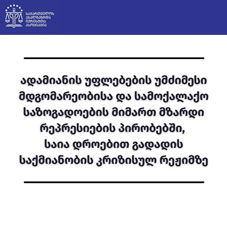
Georgian Young Lawyers' Association Cuts Free Legal Aid, Enters 'Crisis Mode'
By Messenger Staff
Monday, March 16, 2026
The Georgian Young Lawyers' Association (GYLA), one of Georgia's most prominent human rights groups, said it will temporarily scale back its free legal aid services and focus only on strategic litigation, citing increasing pressure on civil society.
"Under the gravest human rights situation, GYLA is temporarily shifting to a crisis working mode and will continue providing legal assistance only in the direction of strategic litigation," the organization said in a statement released on March 14. It added that it will continue monitoring human rights, documenting violations, and issuing "public, clear, and substantiated" responses to abuses.
The group said the current climate has affected several key areas of its work, including legal aid. As a result, "thousands of citizens will no longer be able to receive the support they previously obtained annually through daily free in-person, telephone, or online consultations, document preparation, and court representation."
Founded in 1994, GYLA has operated for more than three decades with offices across Georgia, providing legal assistance and representing human rights cases, including in international courts. According to the organization, its lawyers have delivered more than 1.3 million free legal consultations and services across the country's nine regions since its founding. The group has also regularly deployed election observation missions.
The decision comes as the ruling Georgian Dream party continues to adopt legislation that critics say targets civil society and independent media by restricting their funding sources.
Ten days before the announcement, the Georgian Dream-led parliament approved another package of laws expanding the definition of what qualifies as a "grant" requiring government approval and introducing criminal penalties for violations.
"Today, civil society organizations are operating in one of the most difficult environments in the history of independent Georgia," GYLA said. The organization added that the situation "has forced a significant part of civil society organizations to either completely halt or sharply reduce their activities, while the real risk of criminal prosecution has established a constant regime of pressure on their work."