Prepared by Messenger Staff
European Commission Calls Khoshtaria Sentence Disproportionate
European Commission spokesperson Anitta Hipper criticized the sentence handed down to Georgian opposition politician Elene Khoshtaria, calling it "disproportionate."
"The sentence handed down to another opposition politician, Elene Khoshtaria, which provides for 18 months of imprisonment, is considered disproportionate by us," Hipper said during a briefing, responding to a question from a Publika journalist about the verdict.
She elaborated, "The verdict against another opposition politician, Elene Khoshtaria, which envisages 18 months of deprivation of liberty, is disproportionate in our view. This once again demonstrates that the Georgian authorities are acting contrary to basic democratic standards. We regard this as a continuation of democratic repression that must end. This is part of the repression directed against the opposition, journalists, civil activists, and those people who are fighting for fundamental rights and freedom of expression. Our message is clear: all persons unjustly detained must be released."
Khoshtaria, leader of the Droa party, was charged with damaging a campaign banner of Kakha Kaladze. The Tbilisi City Court, presided over by Judge Giorgi Arevadze, found her guilty and sentenced her to 1 year and 6 months in prison. Under the ruling, Khoshtaria is expected to be released from the penitentiary in one year.
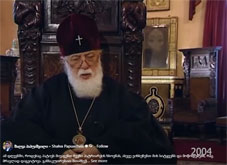
Papuashvili Reflects on Patriarch Ilia II's Interview from 2004
Georgian Dream-led Parliament Speaker Shalva Papuashvili shared an interview with Ilia II from 2004, saying the Patriarch foresaw the challenges that would face both the Church and the nation.
"When it seemed that new hopes were arising, Ilia II was already seeing future threats. In his words spoken in 2004, the entire architecture of the trials the nation and the Church would face is clearly outlined," Papuashvili wrote. He explained that the Patriarch spoke about external forces "that do not want a strong Church in Georgia. They do not want a Church that unites the people, protects their identity, and strengthens their spiritual foundation."
Papuashvili emphasized that divisions are no longer defined by foreign alignment. "There is no longer any pro-Western or anti-Western, pro-Russian or anti-Russian, pro-Chinese-Iranian-European or otherwise. There is only Georgian and anti-Georgian," he said. "There exists a patriot who serves their own country, acts in its interests, and carries its burdens; and there exists a protester who acts consciously or unconsciously for foreign interests, standing under their flags, enchanted by foreign influence. Here lies the line. We have been in this struggle for many centuries. It is a struggle for faith, identity, and freedom-and in this struggle, we will prevail, just as we have for centuries."
Papuashvili noted the Patriarch's enduring role as a guide through turbulent times. "Under his guidance, the Church became a refuge, the only anchor in an era when the storm did not subside. The brutality of atheism, persecution, the erosion of identity, civil conflict, poverty, and despair-at the center of all this stood the Church, as the last bastion," Papuashvili wrote. He added that Ilia II "lived to see the time when the most important national concepts returned to the agenda of state policy-independence, sovereignty, freedom, and statehood, whose spiritual foundation is the two-millennia-old Georgian Church."
According to Papuashvili, the Patriarch's foresight and steadfastness made him "the true father of the people. He was a unifier, even when society was divided. He was a diplomat, but never compromised on matters concerning Georgia's national and spiritual values."