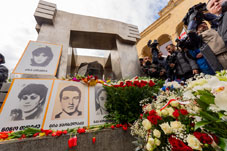
Georgia Marks April 9 Amid Growing Political Friction
By Messenger Staff
Friday, April 10, 2026
Georgia marked April 9, a national day of remembrance that commemorates both the 1989 massacre of protesters by Soviet forces and the 1991 declaration of the country's independence.
The commemorations took place against a backdrop of ongoing domestic political friction.
The day honors the 21 people killed by Soviet troops during a pro-independence rally on Rustaveli Avenue 37 years ago. It also marks 35 years since the Supreme Council used that same date to formally declare Georgia's break from the Soviet Union following a nearly unanimous national referendum.
While the morning began with a quiet vigil in the rain, the atmosphere turned volatile when Georgian Dream (GD) leaders arrived. A large police presence pushed back protesters to create a corridor for Georgian Dream Prime Minister Irakli Kobakhidze and other cabinet members to reach the memorial.
As they laid flowers, officials faced vocal hostility from the crowd, with protesters shouting epithets that characterized the leadership as beholden to Russia.
The tension led to several physical altercations and at least two arrests. In one instance, GD lawmaker Beka Davituliani was seen shoving an activist who was shouting at him during a media interview. The 5th President Salome Zourabichvili, who visited the site separately, dismissed the government's participation as "theatre of the absurd," questioning how officials could honor victims of the Soviet regime while pursuing policies critics label as pro-Russian.
Opposition leaders framed the day as a struggle to maintain the independence won in 1991. Leaders from the UNM, Lelo, and the Federalists argued that Georgia's sovereignty is inseparable from its ties to the West, which they claim are being sabotaged by the ruling party.
Diplomats from the United States, the European Union, and several European nations visited the site throughout the day. Specifically, representatives from Lithuania, Latvia, Estonia, Poland, the Czech Republic, France, Germany, Sweden, and Denmark laid flowers to honor the victims. Many of these nations, along with Ukraine and Israel, issued official statements reaffirming their support for Georgia's sovereignty and its people's "European aspirations."
Despite the heavy police presence and verbal clashes, citizens continued to arrive at the memorial late into the afternoon to leave flowers for the 21 victims of 1989, whose names remain a central symbol of Georgia's fight for independence.