SSSG 2025 Report: Claims of Thwarted 'Violent Overthrow' and Hybrid Threats
By Messenger Staff
Thursday, April 23, 2026
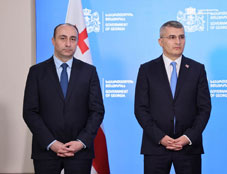
The State Security Service of Georgia (SSSG) released its 2025 annual report on April 21, detailing alleged attempts to destabilize the government through "violent means" and ongoing foreign interference. This document arrived alongside a significant reshuffle in the country's security leadership. Mamuka Mdinaradze, the outgoing head of the SSSG, has been appointed to the newly created role of State Minister for Coordination of Law Enforcement Bodies, while current Interior Minister Geka Geladze is slated to succeed him at the security agency.
A primary focus of the report is a series of events surrounding the October 4, 2025, elections. The SSSG claims that a group operating both within Georgia and abroad planned to provoke civil unrest to change the government by force. According to the agency, this culminated in an attempt by protesters to occupy the presidential palace in Tbilisi, an action that was ultimately thwarted by law enforcement. The report further notes that eight criminal investigations were launched in 2025 regarding sabotage and assistance to foreign actors, leading to the prosecution of 13 individuals by counter-intelligence units.
The agency identified Russia's continued occupation of Abkhazia and the Tskhinvali region as the "greatest threat" to Georgian national security. The report describes an intensified "world order change" where smaller states struggle to maintain sovereign policies against major powers. In the occupied territories, Moscow's influence remains dominant through financial and military levers. For instance, the Tskhinvali region's budget is approximately 80% funded by Russia, while Abkhazia receives roughly 38% of its funding from the same source.
Militarization efforts also expanded in these regions during 2025. The SSSG recorded the opening of a UAV training center in the Tskhinvali region and ongoing work toward drone production in Abkhazia. Meanwhile, the process of "borderization" continued with 55 recorded cases of new artificial barriers and fences, primarily in the Tskhinvali region. Human rights challenges persisted as well, with 74 combined cases of illegal detentions recorded across both occupied zones, often based on fabricated charges of espionage or smuggling.
The report highlights a growing trend of disinformation and propaganda campaigns targeted at the Georgian public. The SSSG expressed particular concern over "double-standard" narratives originating from Western institutions, which the agency claims foster nihilism and distrust toward state institutions. The document specifically cited a BBC investigative report concerning the use of a chemical compound during protests as a piece of "tendentious" propaganda that required a proactive state response to neutralize.
In the digital realm, the SSSG responded to 177 computer security incidents throughout the year. Among these, 14 were classified as particularly significant attacks linked to foreign special services or associated cybercriminals. The agency maintained that it countered these threats while adhering to principles of political neutrality and the rule of law.
Regarding international security, the SSSG noted that no terrorist attacks occurred on Georgian soil in 2025. However, the agency continues to monitor up to 15 Georgian citizens held in Syrian detention camps and has launched 14 terrorism-related criminal investigations. Domestically, the Anti-Corruption Agency remained active, initiating 54 investigations that led to charges against 104 individuals for offenses such as bribery and money laundering. These efforts also resulted in the recovery of more than 126,000 square meters of illegally obtained land, valued at over GEL 1 million, which was successfully returned to state ownership.