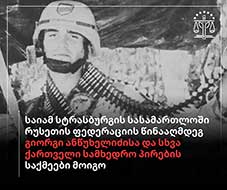
Strasbourg Court Holds Russia Responsible for Killing and Torture of Georgian Prisoners of War in 2008
By Messenger Staff
Wednesday, June 24, 2026
The European Court of Human Rights ruled on June 23 that Russia violated the right to life and the prohibition of torture in connection with eight Georgian prisoners of war during the 2008 war, ordering Moscow to pay compensation to the victims' families and surviving servicemen.
The judgment, delivered in the joined cases of Malachini and Others v. Russia and Chikviladze and Antsukhelidze v. Russia, found violations of both the substantive and procedural aspects of Article 2 (right to life) and Article 3 (prohibition of torture). The applications were lodged in 2009 and 2010, nearly 18 years after the events. The applicants were represented by the Georgian Young Lawyers' Association and the Stichting Justice Initiative. The Georgian government participated as a third-party intervener.
"It is a historic and emotional day," said Tamar Oniani, chair of GYLA. "This is the first time since the 2021 judgment in the interstate case (Georgia v. Russia II) that the Court, in individual cases, examined the issue of the Russian Federation's jurisdiction in relation to prisoners of war, and did not automatically decline to assess the conduct of hostilities."
Article 2 concerned the deaths in custody of Ushangi Sopromadze, Kakhaber Khubuluri, and Giorgi Antsukhelidze. Sopromadze was executed on August 10 after captors identified him as a tank crew member. Khubuluri was executed the following day after being accused of being a "traitor" because of his Ossetian ancestry. Antsukhelidze went missing during fighting in Tskhinvali on August 9; video footage that later emerged showed him being beaten and humiliated in captivity. All three were identified through DNA analysis after their remains were returned to Georgia in November 2008. Antsukhelidze was posthumously awarded the title of National Hero of Georgia.
Article 3 also covered five surviving servicemen, Davit Malachini, Zaza Kavtiashvili, Imeda Kutashvili, Malkhaz Meladze, and Kakhaber Zirakashvili, who were held between August 8 and 19. The Court found they were "interrogated, beaten, had their skin and fingers burnt, and were made to walk on the Georgian flag." In one documented instance, a Russian serviceman threatened to shoot Kutashvili at gunpoint before another Russian soldier intervened. The five were eventually transferred to Georgian custody on August 19 in exchange for Russian prisoners.
The Court found Russia exercised "effective control" over South Ossetia and bore responsibility for the conduct of South Ossetian forces, "without it being necessary to provide proof of 'detailed control' of each of those actions." It also found Russia had "failed to carry out an effective investigation" into the killings or the torture.
The Court ordered Russia to pay EUR 65,000 each to the families of the three killed servicemen and EUR 40,000 each to the five surviving applicants. Whether the awards will be enforced remains unclear. Following its expulsion from the Council of Europe in 2022, Russia adopted legislation refusing to execute ECtHR judgments.