Georgian Dream lash out at Kallas over remarks separating government from Georgian people
By Messenger Staff
Tuesday, July 14, 2026
Top Georgian Dream figures have hit back at EU foreign policy chief Kaja Kallas after she told reporters the bloc has no interest in backing the Georgian Dream government, only its people, a remark she made in response to a question about the EU's Black Sea strategy.
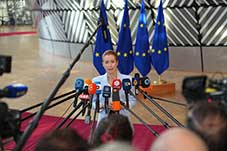
Speaking to journalists as she arrived at the July 13 Foreign Affairs Council meeting in Brussels, Kallas was asked about Georgia's place in the bloc's Black Sea strategic approach, which foreign ministers were reviewing that day, a year after its launch. She said Black Sea nations remain a key piece of that strategy, but added that Georgia poses a particular challenge.
"We don't really have connections with the [GD] government," she said. "We don't want to support the government. We want to support the people of Georgia. We have also had discussions on how we can best do that so that the people do not lose hope in Europe."
Her comments land against a backdrop of deteriorating EU-Georgia relations, driven by what Brussels views as the ruling party's democratic backsliding and hostility toward the bloc. The EU declared last November that Georgia's candidate status exists "in name only," and in February it suspended visa-free travel for Georgian diplomatic and service passport holders.
Georgian Dream Prime Minister Irakli Kobakhidze, Foreign Minister Maka Botchorishvili, and disputed Parliament Speaker Shalva Papuashvili all pushed back, zeroing in on Kallas' choice to draw a line between the government and the population it leads.
A pro-government Imedi TV reporter raised the comments with Kobakhidze after his morning briefing, at which he had already dismissed the OSCE Parliamentary Assembly's Hague Declaration as absurd. Kobakhidze drew a comparison to Russia's refusal to recognize Georgian sovereignty over Abkhazia and South Ossetia. "We have often said that there is one country, the Russian Federation, which does not recognize Georgia's sovereignty over 20% of its territory," he said. "Then there is Ms. Kaja Kallas, who does not recognize Georgia's sovereignty over 100% of its territory." He described her stance as a "shameful attitude" and called it troubling that the bloc's top diplomat "does not recognize, but instead opposes, the will of the Georgian people."
Papuashvili posted Kallas' remarks to Facebook along with his own criticism, arguing they do nothing for Georgia-EU ties and only deepen Georgian public distrust of Brussels. "Such a statement implies that, in Ms. Kallas' view, the Georgian people are incapable of choosing their own government and therefore need external supervision and guidance," he wrote. "This is not support for the Georgian people, but disrespect for their political choice."
Botchorishvili made a similar argument in her own post, calling it regrettable that the EU's top diplomat would say she isn't seeking engagement with a government chosen through Georgians' democratic will while claiming to stand with those same citizens. "Dialogue, not disengagement, is the foundation of a genuine partnership," she wrote, adding that Georgia remains open to "respectful engagement" with the EU for the sake of its citizens and its European future.