The world faces improved infrastructure, but modest progress towards 'No Poverty' path
By Nino Kopaleishvili
Monday, July 27, 2026
UN report 2026 pinpoints Sustainable Development targets achieved since 2015
If trends continue, 351 million women and girls still might be living below the poverty line by 2030, according to recent data released by United Nations.
The Sustainable Development Goals Report 2026, issued by the United Nations this July, monitors tangible progress globally in improvement of the standard of living caused mainly by advancements in technology and infrastructure. However, according to the data, the situation remains dire in terms of gender equality and children's rights.
More than 150 million children suffer from the plight that seriously hinders or slows down growth and development, whereas none of the gender equality targets defined by Sustainable Development Goals (SDGs) have been reached yet, despite some legal reforms undertaken by UN member states to remove laws that neglect binding the gender equality framework.
According to the new data, in 2020-2024 child labour dropped by more than 20 million and since 2012 there has been an apparent decrease in stunting children under five "resulting in 30.2 million fewer stunted children worldwide." 273 million children and young people are out of school. Unemployment and no education or training are high among young people aged 15-24.
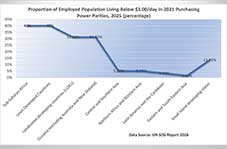
Employment or owning a private business still cannot be regarded as a safe harbour. Last year, 284 million workers (7.9% of the employed population worldwide) were identified as living below the poverty line. A relatively higher figure 11% was noted in 2015 data.
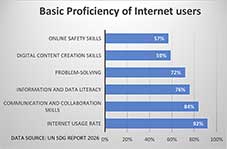
Artificial Intelligence and a considerable increase in internet consumption have made digital literacy a key requirement to obtain employment, facilitate learning or participate in civic life. In the past decade, the percentage of internet users have spiraled up from 40% to 74%.
Recent monitoring of the SDGs reveals that more people have gained access to safe drinking water. In particular, according to the UN release, since 2015 approximately 1 billion people have "gained access to safely managed drinking water and 1.2 billion to safely managed sanitation."
In 2024, water supply and sanitation grants boosted to 7% (USD 3. 4 billion). 92% of the world's population have electricity, while a third of the world's population have electricity from renewable sources. Renewable electricity generating capacity per capita reached 14% in 2024.
According to the UN SDG report 2026, social protection has reached more than half of the global population for the first time. In 2023, 52.4% of the world's population was covered with a type of social protection benefit compared to 42.8% estimated in 2015.
Despite the achievements, 2.3 billion people are still affected by food insecurity in the world and 15 % of SDG targets have dropped below the 2015 baseline. Approximately half of the SDG targets are marked with the signs of deterrence in implementation.
The external debt of low- and middle-income countries hit a record USD 8.9 trillion in 2024, says the UN SDG press release published this July. The situation is on alert regarding a climate change, as global temperatures achieved 1.43°C above pre-industrial levels in 2025, resulting in atmospheric carbon dioxide's highest concentration in two million years.
In 2023-2024 Official Development Assistance (ODA) grants on poverty reduction, a financial assistance to developing countries without an obligation of repayment, dropped to 8.7% (USD 19.1 billion, a total fall by 23.1% in 2025 and turnback to 2015 levels) significantly reducing the financing of basic health, food assistance, education and other social infrastructure. The total ODA grants on poverty reduction amounted to 0.02 % of the gross national income (GNI) of donor countries in 2024, the same share as monitored in 2015.
The United Nations have presented Sustainable Development Report 2026 on July 7, this year. In the last decade, the organization has been able to create a global database to cover more than 3.2 million data points that includes almost all indicators and gives an opportunity to countries to monitor their own progress.
The top performers in reaching the SDG targets are Finland, Sweden, Denmark, and Norway.
The UN adopted the Sustainable Development Goals and corresponding 139 SDG targets in 2015. The UN member countries have committed to reach the SDG targets by 2030.