Global Temperatures Pose Threat to Food and Water Supply
By Nino Kopaleishvili
Monday, September 7, 2026
El Niño Promises The Hottest 2027, Scientists Say
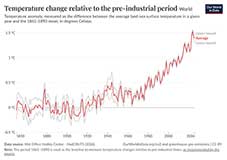
The growth of global temperatures will cause severe human health damage, food and water supply scarcity, and harm to nature, cities, and the global economy in the coming years, the United Nations warns. Scientists also anticipate that 2027 could be the hottest year on record due to rising sea surface temperatures triggered by El Niño climate patterns.
The anticipated crossing of global temperatures beyond 1.5°C above pre-industrial levels in the coming years raises alarms regarding nature protection and human development. The latest UN report warns that under "intensified extreme weather," the world will witness "ecosystem loss, and submersion of Small Island Developing States (SIDS) and low-lying coastal cities".
Furthermore, "irreversible changes to ice sheets" will occur, and glaciers could lose a quarter of their mass by 2100-raising sea levels by 12.5 cm-according to the UN report Limiting Overshoot, published this September.
To achieve net-negative emissions and bring global temperatures back below 1.5°C by the end of the 21st century, scientists emphasize that rapid, dynamic measures for fossil fuel emission reductions and carbon dioxide elimination are urgently needed. A three-phase strategy suggested by the report envisions an immediate response, coping and containment, and long-term resilience.
The report places higher accountability on countries that historically bear more responsibility for climate change and underlines the need for strong political will and a multilateral approach to implement effective policies combining inclusive governance and finance. Climate interventions, such as improved air quality, public health, lower energy costs, secure access to electricity, and equity, contribute directly to resolving the climate crisis.
In an analysis for Berkeley Earth, scientists Robert Rohde and Zeke Hausfather noted that the El Niño pattern has strengthened rapidly: "Forecasts now favor it becoming the strongest El Niño on record, peaking late in 2026," scientists wrote in their Temperature Update Report.
El Niño is a global climate cycle occurring every three to seven years, marked by warmer ocean surface waters and shifted atmospheric energy patterns. The expected ocean sea-surface temperature peak anomaly for this 2026-2027 cycle is roughly 3.6°C above average,approximately 0.8°C higher than the peak recorded during the 2015-2016 event (2.75°C). Writing for The Climate Brink, Hausfather noted that while the cycle began with "La Niña-ish conditions" earlier this year, "it may end up the strongest by a truly mind-blowing margin."
The Guardian reports that El Niño's impacts are already visible worldwide, from escalating wildfires in Indonesia to weakened monsoon rains in India. Fire risks are expected to rise across Australia, while intense flooding could hit South America. The daily cites a World Food Programme statement warning that one of the heaviest outcomes will be leaving approximately 50 million people facing acute hunger.
Excessive fossil fuel emissions and the climate crisis have already taken a devastating toll across Europe. According to news agency AFP, recent record-breaking summers saw over 1,000 wildfires burn through more than 540,000 hectares (~1.33 million acres) of land across the European Union.
According to the European Forest Fire Information System (EFFIS), four of the 15 largest fires over the last decade occurred during a single summer season within the EU. Media reports confirm that due to wildfires and severe droughts, more than 360,000 people across Europe and Britain were forced to evacuate.