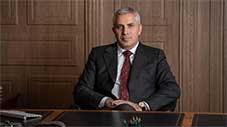
Kambolov Declared Winner of Tskhinvali 'Presidential Vote,' West Condemns Process
By Messenger Staff
Monday, September 21, 2026
Acting de facto leader Marat Kambolov was declared winner of the early so-called "presidential vote" held on September 18 in Russian-occupied Tskhinvali/South Ossetia, a process that has drawn condemnation from Tbilisi and Western governments including the EU, Norway and the UK.
Preliminary results from the local "central election commission" gave Kambolov 84.95% of the vote, an outcome widely expected after he received open endorsements from local political groups and from Russian President Vladimir Putin.
Murat Valiev, an employee of Tskhinvali's "State Guard Service," placed second with 3.82%, followed by Kazbeg Kodoev, an advisor to the rector of "South Ossetian State University," with 2.52%, and Zurab Kokoev, leader of the "Unity" party, with 1.48%. Around 4.9% of voters cast ballots against all four candidates, according to the de facto election body. Turnout was put at 82.65%, with 32,869 of 39,768 registered voters taking part.
The early vote followed the resignation of former de facto president Alan Gagloev in June, after he moved to Russia to serve as an adviser to Putin. Kambolov, who was born in North Ossetia and had no prior ties to the region, had been appointed the region's "prime minister" a week before Gagloev stepped down, then took over as interim leader. Four candidates registered for the race in total: Kambolov, Kodoev, Valiev and Kokoev.
The vote came after Tskhinvali and Moscow signed a so-called "Treaty on Deepening Allied Cooperation" on May 9, which among other provisions allows "citizens" of each side to hold state and municipal positions in the other.
Georgia's Foreign Ministry rejected the vote's legitimacy in a September 18 statement, calling it a violation of international law that "cannot confer legitimacy on the occupation regime and does not alter the international legal status of the Tskhinvali region as an integral part of Georgia." The ministry added that holding any elections in occupied Georgian territory while Russia maintains military control, and while displaced Georgians remain unable to return home, "is illegal and cannot produce any legal effect under international law."
Tbilisi also condemned Russia's decision to hold State Duma elections in occupied Abkhazia and Tskhinvali from September 18 to 20, saying the opening of polling stations there amounted to "yet another gross violation of Georgia's sovereignty and territorial integrity" and reflected Moscow's push toward de facto annexation of Georgian regions.
The European Union said in a September 18 statement that it does not recognize the legal framework behind the vote, including recent amendments to it, and called the result "null and void." The bloc said it "strongly condemns the actions undertaken by Moscow to have a Russian official appointed as de facto President" of South Ossetia, criticized the May 9 treaty, and denounced continued efforts by Russia to fold the region into its political, military, economic and judicial systems. The EU said these steps run counter to peaceful conflict resolution and represent moves toward the region's illegal annexation, warning that they "systematically entrench division, endanger regional security and stability, and grossly violate international law."
UK Minister for Europe, Eastern Europe, International Security and Growth Stewart Wood wrote on X that attempts to deepen Russian control over Georgia's occupied regions "undermine Georgian sovereignty and Georgian territorial integrity and will not go unanswered," adding that Russia must meet its obligations under the 2008 ceasefire agreement.
Norway's Foreign Ministry also said it does not recognize the vote, warning that Russia's gradual political integration of Georgia's occupied territories, and its moves toward full annexation, are concerning and undermine Georgian sovereignty.
Separately, Putin sent Kambolov a congratulatory letter marking "Republic Day," in which he described relations between Russia and South Ossetia as developing successfully "in the spirit of good-neighborliness and alliance." Putin said Moscow and Tskhinvali were cooperating productively across various fields and working together to strengthen regional security and stability, adding that the two sides would continue joint efforts to deepen their partnership. He also pledged continued Russian support for South Ossetia's authorities and population, saying Moscow would keep providing assistance as the region pursues state-building and economic development.