EU Ambassador Reaffirms Support for Georgia's European Future Amid Strained Ties
By Messenger Staff
Monday, October 12, 2026
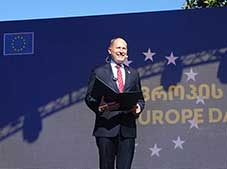
The friendship between Georgia and the European Union dates back to the beginning of Georgia's independence and cannot be erased by recent anti-European rhetoric, EU Ambassador to Georgia Pawel Herczynski said at a Europe Day 2026 event organized by the EU Delegation in Telavi, Kakheti.
Addressing guests in Georgian, he welcomed the celebration of Europe Day in Kakheti for the first time, describing the region as a place where Georgia's free spirit, culture and traditions are especially evident and as a treasure the country brings to Europe.
The ambassador said the European Union was neither a new nor an alien story for Georgia. In a world full of challenges, he said, the EU had spent nearly 80 years building peace, democratic development and economic prosperity through hard work, dedication and commitment to shared values.
"Our unity is precious to us. This is why we want to share it with those who will respect our common rules," Herczynski said.
Comparing the EU to Georgian polyphonic music, he said its 27 independent member states form a strong unity, just as individual voices come together to create a melody. He expressed hope that Georgia's voice would one day ring out clearly within Europe's polyphony.
"The history built over decades cannot be rewritten or forgotten in just a few years. We will continue supporting Georgia's democratic and European future," he said.
"You do not have to choose to be either Georgians or Europeans. You can be both. You are both," the ambassador added.
Concluding his speech with a Kakhetian toast, Herczynski said: "Such is the passing world: Night gives way to dawn. What hatred has destroyed, Love has built anew."
"Long live Georgia, long live Europe! Go forward Georgia, go forward!" he said.
Speaking to the media, Herczynski said the European Commission's next enlargement report would be published in three weeks. He described the previous report, published in November 2025, as "devastating" for Georgia and said the situation had deteriorated further over the past year, particularly regarding fundamental freedoms.
The ambassador said recent remarks by European Commissioner for Enlargement Marta Kos were personally disheartening but reflected the consequences of the Georgian government's actions, legislation and anti-European rhetoric.
"Regrettably, there are consequences, and regarding the enlargement process, the European Commission will present another enlargement report in three weeks," Herczynski said.
He said he would hold another press conference after the report's publication, while the EU's foreign policy chief and the enlargement commissioner would also hold a press conference in Brussels.
"Let us see what the European Commission's assessment will be in three weeks," he added.
Herczynski said EU foreign ministers would discuss what he called "the deteriorating situation in Georgia" at a meeting on Monday, October 12.
He said ministers regularly discuss Georgia because of concerns about human rights and the state of democracy.
"In today's Georgia, people go to prison for standing on the sidewalk. People go to prison for Facebook posts," he said.
The ambassador also criticized the departure of EU and member-state funding from Georgia, saying the funds had supported the country's sovereignty and development.
"Funds from the EU and its member states, which have always supported Georgia's sovereignty and development, are being driven out of the country," he said, describing the situation as extremely problematic.
Asked whether he saw genuine readiness on the Georgian Dream government's part to restore relations with the EU, Herczynski said the authorities had repeatedly ignored calls to change course.
"For two and a half years, we have been urging the Georgian authorities to change their trajectory, provided, of course, that they are seriously interested in ever joining the European Union," he said.
He pointed to European Council conclusions published in June 2024 that called on Georgia to change course and were agreed upon by all EU member states. Further conclusions followed in October and December 2024. Herczynski referred the authorities to paragraph 138 of the December 2024 enlargement conclusions, which sets out steps for returning to European integration.
"All our calls have been ignored," he said.
The ambassador also referred to what he described as an unprecedented recent attack on the EU, its institutions, the European Parliament and the leaders of EU institutions.
"This is very unfortunate for me, but this is today's reality," Herczynski said.