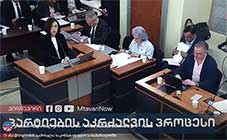
Tsitlidze Challenges Georgian Dream's Case to Ban Opposition Parties
By Messenger Staff
Wednesday, October 28, 2026
United National Movement (UNM) representative Ana Tsitlidze challenged Georgian Dream's lawsuit seeking to ban opposition parties during a hearing at the Constitutional Court on October 27, arguing that the case relies on selective interpretations of past events and applies different standards to the former ruling party and its political opponents.
Tsitlidze addressed allegations concerning the UNM's time in power, including the 2007 Kodori Gorge operation, prison footage, privacy violations, corruption and cases of political violence. She argued that alleged wrongdoing by individual officials cannot, by itself, justify dissolving an entire political party.
She also warned that treating criticism of the government, challenges to election results and cooperation between opposition parties as grounds for a ban would undermine political pluralism and constitutional protections for political association.
Addressing the lawsuit's references to former Justice Minister Zurab Adeishvili, Tsitlidze argued that the same standards should apply to officials who served in the institutions of that period and remain influential in the justice system.
"Personally, if the Constitutional Court decides to ban political parties-specifically the 'United National Movement'-then you must ban me as well. For the record, I have only seen Zurab Adeishvili once in my entire life," she said.
"And this does not mean that I am distancing myself from anything or trying to avoid something. I am simply stating it," she added.
Tsitlidze questioned the role of Constitutional Court judge Vasil Roinishvili, whom she described as a former deputy chief prosecutor and "part of Zurab Adeishvili's immediate inner circle and a significant figure within the system."
"How can an individual be barred from political activity due to the past actions of someone they have met only once in person-while, at the same time, a former high-ranking official from that very same system is working in the court and participating in the administration of constitutional justice?" she asked.
She cited the cases of Sandro Girgvliani and Roin Shavadze as examples of what she described as inconsistent treatment of past abuses. Levan Murusidze, the judge in the Girgvliani case, was later appointed by Georgian Dream to an indefinite judicial term. Resan Kontselidze, the lead investigator in the Shavadze case, served as a Georgian Dream majoritarian MP from 2020 to 2024.
"For 'Georgian Dream,' the activities of Murusidze and Chinchaladze prior to 2012 are considered criminal-invoked whenever they need a pretext to ban the opposition-yet, after 2012, these same activities are framed as integrity and independence. This is a double standard, and through this double standard, you are undermining the very concept of justice," Tsitlidze said.
She also raised the cases of Iuri Vazagashvili and Guram Sharadze, saying no UNM leader had been charged in connection with Vazagashvili's murder, while the person arrested in the Sharadze case had cited personal revenge.
Referring to the beatings of Koba Davitashvili and Valeri Gelashvili, Tsitlidze argued that individual responsibility for past violence should not be used to ban an entire party.
"Since individual liability has been established in these cases, could this serve as grounds for banning a party? If so, I could just as easily remind Georgian Dream of the cases involving the beatings of Levan Khabeishvili, Davit Katsarava, Zviad Maisaishvili, Guram Rogava, and more than 500 other citizens who were beaten and left bloodied. You cannot demand the dissolution of parties based on isolated acts of violence from the past, while today you are perpetrating extreme violence and political retribution against citizens and opposition figures," she said.
Tsitlidze challenged the lawsuit's account of the 2007 special operation in the Kodori Gorge, describing it as "a top-tier special operation carried out by Georgian military personnel."
She said she had provided testimony concerning two participants, Sergo Ubilava and Aleksandre Danelia, whom she met before their deaths. According to Tsitlidze, the two men told her that Russian nationals had been present during their interrogations.
"For years, Russia has demanded that the identities of these individuals be established. Fourteen years later, a participant in the Kodori special operation died under unclear circumstances. I have provided testimony regarding the participants in the Kodori special operation-specifically, I met with two of them, Sergo Ubilava and Aleksandre Danelia, before they died," she said.
"The circumstances of this case require an independent investigation," she added.
Tsitlidze also disputed the lawsuit's references to prison footage, citing Tamaz Elizbarashvili and Lado Bedukadze, who she said had spoken about how the recordings were staged. She referred to the cases of Giorgi Rurua and Giorgi Akhobadze in connection with allegations that drugs and weapons had been planted.
On privacy violations, she argued that the circulation of private recordings should be examined consistently, including footage involving journalists and politicians that circulated during Georgian Dream's time in power. She also cited leaked State Security Service dossiers in 2021.
Turning to corruption, Tsitlidze challenged the claim that alleged wrongdoing under the UNM demonstrated systemic criminality. She pointed to allegations involving former State Security Service head Grigol Liluashvili, in connection with a call-center case involving alleged fraud against European pensioners, and former Defence Minister Juansher Burchuladze, who was arrested on corruption charges. She also cited the case of former Prime Minister Irakli Garibashvili.
"In short, let me put it this way: they didn't find anything among the higher-ranking leaders of the National Movement, but they did find it at the home of their Prime Minister, Irakli Garibashvili," she said.
Tsitlidze questioned Georgian Dream's response to former Prime Minister Giorgi Gakharia after the events known as "Gavrilov's Night," asking why the ruling party had not distanced itself from him and instead appointed him prime minister. She made a similar argument about Irakli Garibashvili following the violence of July 5, saying the party had continued to support him.
She defended the 2021 memorandum between the UNM and Gakharia's party, under which the parties agreed not to field candidates against one another in certain constituencies.
Tsitlidze also referred to the death of Nugzar Putkaradze, a UNM member of Batumi City Council, on November 18, 2021. The party subsequently released information and audio recordings alleging that Putkaradze had faced pressure and attempted bribery.
She raised the case of a UNM member in Senaki who disappeared shortly before a City Council session and later said he had been abducted by Georgian Dream representatives. Tsitlidze said investigators had shown no interest in the allegations.
Addressing the case of the Afrasidze family, she argued that investigators had focused on family members for years without sufficiently examining the victims' circumstances. She questioned why Gocha Jakaia's testimony had not been heard, saying he had been kidnapped by members of the Afrasidze family and freed during a special operation. She also asked why Gia Baramidze had not been charged if there were grounds to do so.
Tsitlidze challenged the lawsuit's claims about constitutional amendments that redistributed powers between the president and parliament, arguing that the changes were intended to consolidate power. She pointed to Tengiz Sharmanashvili, who headed the secretariat of the commission responsible for the amendments. His brother chaired Adjara's Supreme Election Commission from 2004 to 2008, worked in the UNM's legal department and later represented the party at the Central Election Commission.
Tsitlidze asked the court to obtain the minutes of the Council of Europe session at which a 2008 resolution cited in the lawsuit was discussed. She claimed that Georgian Dream representatives supported Russia's position on the resolution's fifth point, while the UNM and its European partners opposed it.
"A logical question arises: if this resolution was directed against Georgia's state interests-as Georgian Dream and the plaintiff side allege-then why did the Russians support it?" she asked.
According to Tsitlidze, the minutes also recorded Russia's delegation leaving the hall in protest during the resolution's adoption. She argued that the relevant records should have been submitted to the court.
She also questioned why the Administrative District of South Ossetia had been considered unconstitutional only after its heads had been appointed over a period of 13 years.
Tsitlidze rejected Georgian Dream's claim that the opposition's cooperation with international partners and calls for sanctions were directed against Georgia. She argued that supporting European integration and informing international partners about democratic backsliding and human rights violations were legitimate political activities.
"The international community imposes sanctions based on its own foreign policy and legal criteria when it perceives that democratic institutions within a country are under threat," she said.
Tsitlidze maintained that the lawsuit should be assessed on specific legal grounds and evidence, rather than political accusations or selective interpretations of past events.