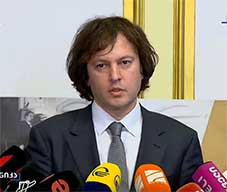
Kobakhidze Urges Russian Leadership to Review Restrictions on Georgian Wine Companies
By Messenger Staff
Friday, November 27, 2026
Georgian Dream Prime Minister Irakli Kobakhidze has called on Russia's top leadership to review restrictions imposed on Georgian wine companies, arguing that the measures lack any factual basis and could run counter to Moscow's own interests. He also said it would soon become clear whether the restrictions were the result of a misunderstanding or whether, as he suggested, the so-called "Deep State" had played a role.
Speaking to journalists, Kobakhidze said Russia had no reason to place Georgian companies on a sanctions list without evidence or proper justification.
"I do not think it is in Russia's interest to include Georgian companies on a sanctions list without any facts, arguments, or basis," he said, urging senior Russian officials to examine the issue and make a decision that serves their country's interests.
Kobakhidze suggested that officials at the middle levels of the Russian bureaucracy might be acting against the interests of their own government. He said that if the restrictions were the result of a misunderstanding, they would soon be lifted. If not, he added, the Georgian side would have to address the issue.
"We hope that the highest echelons of power will look more deeply into this issue and properly evaluate everything that is happening," he said, adding that the position presented to the Georgian side had not been supported by facts.
Kobakhidze's comments follow the November 19 meeting in Minsk between Georgia's special representative for relations with Russia, Giorgi Zurabashvili, and Russian Deputy Foreign Minister Mikhail Galuzin. Zurabashvili said after the meeting that lifting restrictions on Georgian wine producers had been the main priority for the Georgian side.
According to Zurabashvili, Galuzin cited three reasons for the restrictions: concerns about the quality of Georgian wine, allegations that the affected companies were financing Ukraine's war effort, and claims that they had engaged in anti-Russian messaging.
Zurabashvili rejected all three allegations, saying Georgian wine had a strong international reputation and that Galuzin had failed to provide evidence to support the accusations. He also said the Russian official had indicated that Moscow was considering restrictions on two additional Georgian wine companies.
The restrictions followed Russian measures affecting products from several major Georgian wine producers. Tbilisi has sought to have the measures lifted, but the latest meeting did not produce a breakthrough.
Kobakhidze said the situation would soon show whether the so-called "Deep State" had been involved or whether the restrictions were simply based on a misunderstanding. He called on Russia's senior leadership to intervene and ensure that decisions were made in line with the country's own interests.
Kobakhidze also addressed the possibility of restoring diplomatic relations with Russia, ruling it out until Georgia's territorial integrity is restored.
"Until Georgia's territorial integrity is restored, diplomatic relations with Russia cannot be restored," he said.
Kobakhidze stressed that diplomatic relations require formal bilateral agreements and the establishment of embassies in both countries. He noted that Georgia and Russia currently have no diplomatic relations and argued that Georgia should not face criticism for maintaining this position while other countries, including Moldova, continue to have ties with Moscow.
He said he had repeated his position many times and would continue to do so: the restoration of Georgia's territorial integrity remains a precondition for re-establishing diplomatic relations.
Georgia severed diplomatic relations with Russia following the 2008 war. Moscow continues to recognise Abkhazia and the Tskhinvali region as independent states and maintains a military presence in both territories.